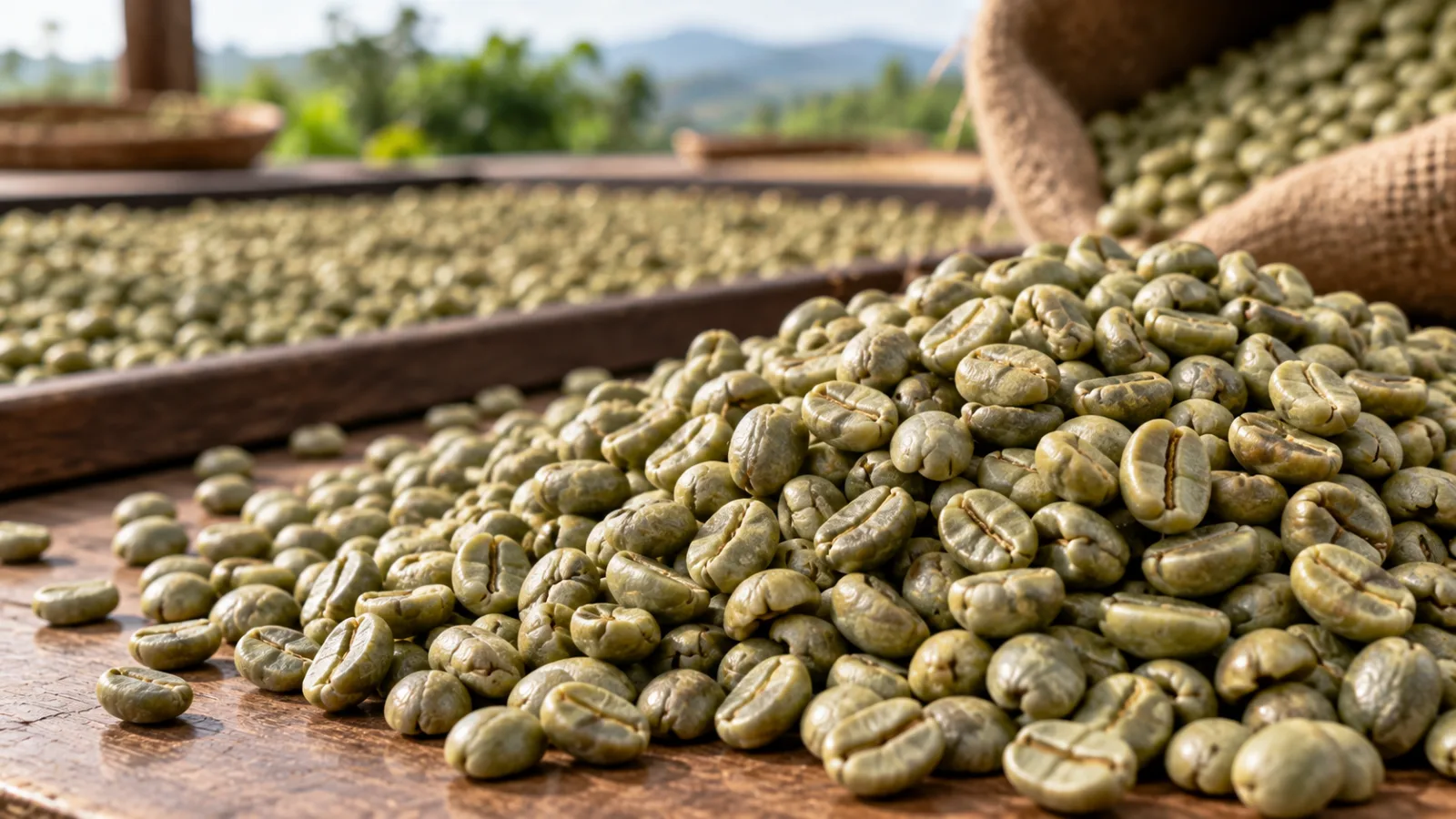
Why buyers choose Uganda Robusta coffee
Uganda is one of the world's largest Robusta origins and the only major one in Africa, which is why Uganda Robusta coffee is a standard component in espresso blends and soluble programmes. The coffee is grown mostly by smallholders under shade at 900–1,300 metres — high for Robusta — from traditional Nganda and Erecta types alongside newer Kisansa lines. The combination gives a denser bean and a cleaner, sweeter cup than lowland Robustas: low acidity, heavy body, cocoa and cereal notes, and a neutral character that blends without harshness. Screen 18 and washed lots are used by espresso blenders looking for crema and body; Screen 15 and 12 go into blends and soluble production; BHP is an industrial grade.
Grade comparison
| Grade | Sieve | Typical use | Export share, Dec 2025 | Reported export value, Dec 2025 |
|---|---|---|---|---|
| Screen 18 | 18/64" ≈ 7.1 mm | Espresso blends, single-origin Robusta, premium soluble | 12.1% | US$4.54/kg |
| Screen 17 | 17/64" ≈ 6.75 mm | Blends | 7.2% | US$4.47/kg |
| Screen 15 | 15/64" ≈ 6.0 mm | Blends, soluble; the standard export grade | 51.7% | US$4.44/kg |
| Screen 12 | 12/64" ≈ 4.8 mm | Soluble, industrial blends | 12.7% | US$4.40/kg |
| BHP 1199 | Broken hand-picked | Industrial | 10.3% | US$3.42/kg |
| Washed Robusta | Wet-processed | Specialty espresso, fine Robusta | 0.09% | US$5.01/kg |
Shares and unit values are Uganda's reported export figures for December 2025 (MAAIF export report, via VirginCoffee, February 2026). They are historical reference points, not our prices; every offer is quoted against your specification, shipment window and the prevailing London Robusta differential.
Grade pages: Screen 18 · Screen 15, 17 and 12 · Single-origin and specialty Robusta.
Green Robusta coffee beans: what you receive
Every grade on this page is supplied as green (unroasted) Robusta coffee beans: hulled, cleaned, screen-graded, density- and colour-sorted, then bagged in 60 kg jute at the grading factory. A 20 ft container holds 320 bags (19.2 tonnes); hermetic liners are available on request. Lots ship FOB Mombasa with the export quality certificate, phytosanitary certificate and certificate of origin, and each lot page shows the measured moisture, defect count and screen retention from the grading report. Roasters and blenders who want 100% Robusta rather than a blend component most often specify Screen 18 or a washed lot.
Processing
Ripe cherry is dried whole on tarpaulins or raised beds to about 12–13 percent moisture; the dried cherry is called kiboko. Kiboko is hulled to remove skin and parchment, producing FAQ (fair average quality) green Robusta, which is then cleaned, destoned, graded by screen, density-sorted and colour-sorted at a grading factory. Export lots are bagged in 60 kg jute, sampled and inspected before the quality certificate is issued. Washed Robusta follows the Arabica route — pulped, fermented, washed and dried as parchment — and is a small, premium category. See processing for the full explanation.
Who buys which grade
Espresso blenders and roasters usually specify Screen 18 or washed lots for crema and body, sometimes Screen 17 for cost. Soluble and RTD manufacturers work in Screen 15 and 12, valuing consistency and yield. Traders and importers carry Screen 15 as the liquid benchmark grade, with 18 and 12 as differentials. Specialty roasters are the main audience for washed, honey and anaerobic lots and for single-origin Uganda Robusta, bought in pallet quantities.
Harvest and shipment windows
The central belt's main crop is harvested from October to February with a fly crop from May to August; fresh-crop Robusta is typically ready for shipment from December. Western Robusta runs roughly on the opposite cycle, which is why Uganda can offer Robusta for most of the year. The harvest calendar has the month-by-month view.
Specification documents
Each published lot carries its measured moisture, defect count, screen retention and, where cupped, a cup profile from the cupping report. We do not publish estimates as specifications. If a value you need is not shown, ask for it — “available on request” means exactly that.
Frequently asked questions
What is the difference between Uganda Robusta Screen 18 and Screen 15?
Screen size. Screen 18 beans are retained on an 18/64-inch sieve (about 7.1 mm) and are the largest standard grade, used in espresso blends and premium soluble; Screen 15 beans are retained on a 15/64-inch sieve (about 6.0 mm) and make up around half of Uganda's Robusta exports. Both are natural-processed and meet the same moisture standard; Screen 18 typically commands a premium of a few cents per kilogram.
Is Uganda Robusta good for espresso?
Yes. Uganda Robusta's density, low acidity and cocoa character make it a common component of Italian-style espresso blends, and Italy is the largest destination for Uganda coffee. Screen 18 and washed lots are the grades most often specified for espresso.
What moisture content does Uganda Robusta ship at?
The export standard is a maximum of 12.5 percent; well-prepared lots typically ship at 11–12.5 percent. We publish the measured moisture of each lot at the time of grading.
How is Uganda Robusta packed?
In 60 kg jute bags, 320 bags to a 20 ft container (19.2 tonnes). GrainPro or similar hermetic liners are available on request for lots that need extra moisture protection during long transits.
Can I get a single-origin Uganda Robusta?
Yes. Screen 18 and washed lots from a named district or farmer group are available as single-origin Robusta for roasters who want to feature the coffee rather than blend it. Traceability level is stated per lot. Details and current preparations are on the single-origin and specialty Robusta page.
What is BHP?
BHP stands for broken hand-picked: broken and small beans that pass the Screen 12 sieve, hand-picked to remove foreign matter. It is an industrial grade for soluble and low-cost blends, priced well below whole-bean grades.