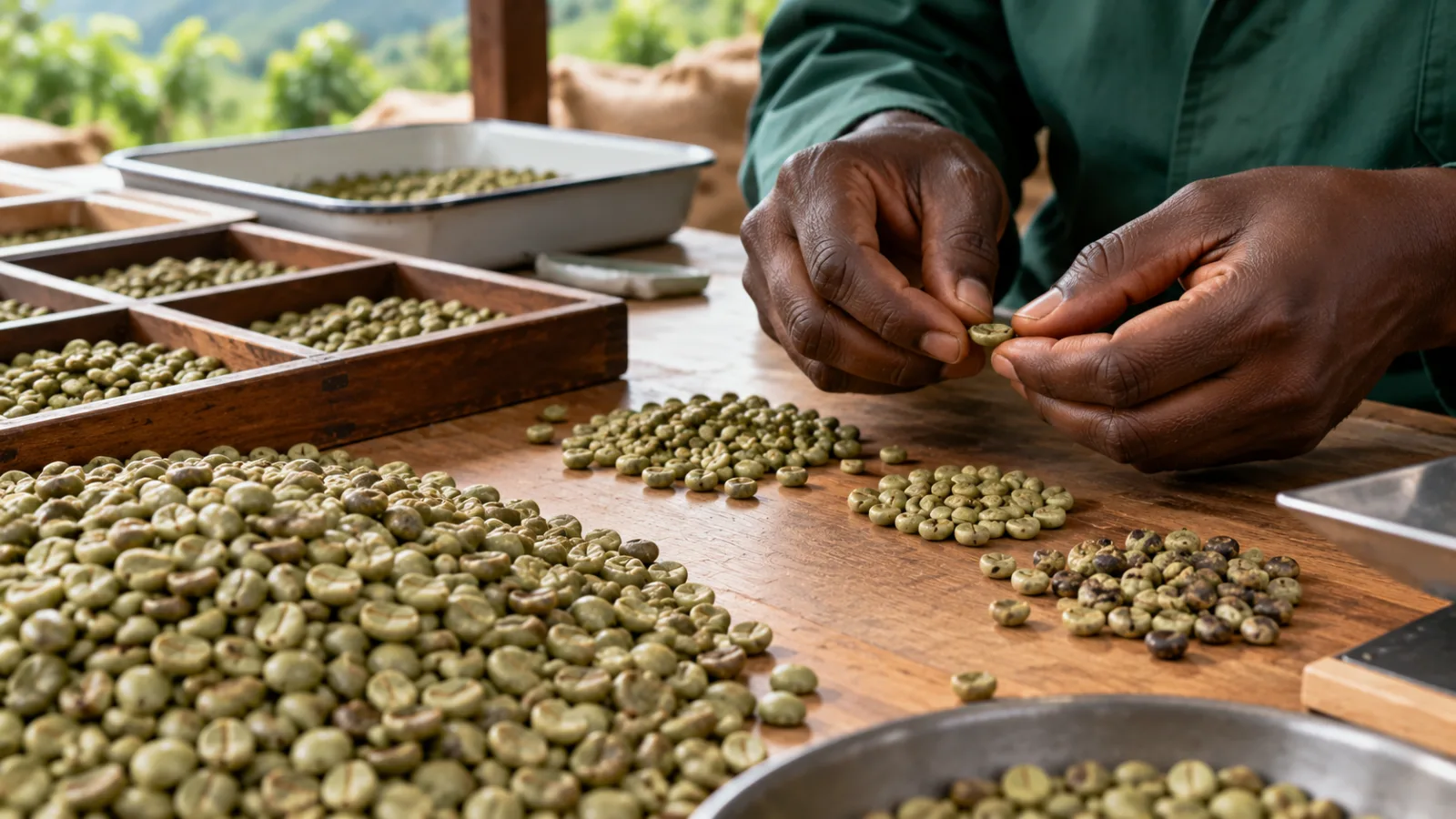
What importers get from us
- A straight offer list. Available and expected lots by grade, with measured specifications; no indicative lots dressed up as stock.
- Specification discipline. The pre-shipment sample is drawn from the prepared export lot, not a representative bag, and nothing is stuffed until you approve it. Retained samples are kept for comparison with your arrival sample.
- Programme shipping. Monthly or quarterly containers against a fixed grade and price basis (differential or fixed), with shipment months agreed around the harvest.
- Documents early. Quality certificate, ICO certificate of origin, phytosanitary certificate, commercial invoice, packing list and bill of lading are emailed as they are issued and couriered as originals; you have the set well before the vessel arrives.
- Traceability that matches the lot. Where a lot comes from registered farmer groups with mapped plots, we supply the geolocation and legality data for your EUDR due diligence; where it does not, we say so.
- One point of contact in Kampala who knows the lot.
Grades importers ask for
Screen 15 as the liquid benchmark Uganda Robusta, Screen 18 as the premium natural grade, washed and fine Robusta for specialty customers, and Bugisu AA, Rwenzori and Drugar on the Arabica side. Export shares and reported values by grade are on the Robusta and Arabica hubs.
Licensing and execution
Every Uganda coffee export moves under a MAAIF export marketing licence and with the per-consignment certificates described on the documents page. Ask us for the licence details applying to your shipment and we will send them with the offer; the exporters page explains how to verify any Uganda exporter, including us.
Quality control chain
Cherry or kiboko is bought against moisture and visual standards; the lot is hulled, cleaned, screen-graded, density- and colour-sorted at a grading factory; a pre-shipment sample is drawn and cupped; the lot is bagged, weighed, marked and inspected for the quality certificate; the container is inspected before stuffing and sealed. Moisture, defect count, screen retention and cup data are recorded at grading and published per lot.
Terms
For new relationships the Uganda trade normally works on a documentary letter of credit at sight, or on telegraphic transfer with a deposit and the balance against shipping documents. Cash against documents and open-account terms follow a track record. We confirm terms in each quote.
How to start
Send us your target grades, monthly or annual volume, destination ports and preferred shipment months, and we will reply with the current offer list and what we can programme from the harvest. Use the quote form or email; include your import licence or company registration if you would like us to move straight to samples.
Frequently asked questions
Do you work with importers or only with roasters?
Both. Importers are our natural counterpart for container programmes and for supplying the many roasters who buy pallet quantities landed in their own market.
Can you ship on a fixed differential for the year?
Yes, for Robusta programmes we can agree a differential to the London contract for a series of shipment months, with pricing fixed against the contract by agreement. Terms are confirmed per contract.
What happens if the arrival sample does not match the PSS?
We keep retained samples from every PSS and shipment so a discrepancy can be investigated objectively. Claims are handled under the contract terms, which normally follow ECF or GCA rules.
Which contract rules do you use?
Contracts with European importers normally follow the European Contract for Coffee (ECF); with US importers, the Green Coffee Association (GCA) contract. We confirm the applicable rules in each contract.
Can you provide EUDR geolocation for every lot?
Not every lot. Lots from registered farmer groups with mapped plots can be supplied with plot geolocation and legality evidence; trader-aggregated coffee is traceable to district level. The traceability level is stated per lot so you can plan your due diligence.