The Lake Victoria crescent
Robusta is native to the forests of the Lake Victoria basin, and Uganda's central districts — Mukono, Kayunga and Buikwe to the east of Kampala; Luwero and Nakaseke to the north; Mityana and Mubende to the west; Masaka, Kalungu and Bukomansimbi to the south-west — remain the heart of production. Altitude is 900 to 1,300 metres, unusually high for Robusta, and the lake moderates temperatures. Coffee grows in mixed smallholder gardens under banana and forest shade trees, often with the Katonga river basin's wetlands and the Mabira forest as landmarks.
Types and farming
Two traditional Robusta types dominate: Nganda, a spreading tree, and Erecta, upright. Kisansa — a larger-beaned type — and clonal lines released by Uganda's coffee research programme have been planted widely since the 1990s to replace trees lost to coffee wilt disease. Trees are shade-grown, largely without irrigation or heavy inputs. Farms are small; most coffee reaches exporters through village traders and washing-and-hulling operators who aggregate kiboko (dried cherry).
Harvest windows
The main harvest runs from about October to February and a smaller fly crop from May to August. Western Robusta districts (Bushenyi, Kasese lowlands, Kamwenge) follow a roughly opposite cycle, so Ugandan Robusta is available in some quantity for most of the year. Fresh-crop central-belt coffee is normally ready to ship from December.
Processing and grades
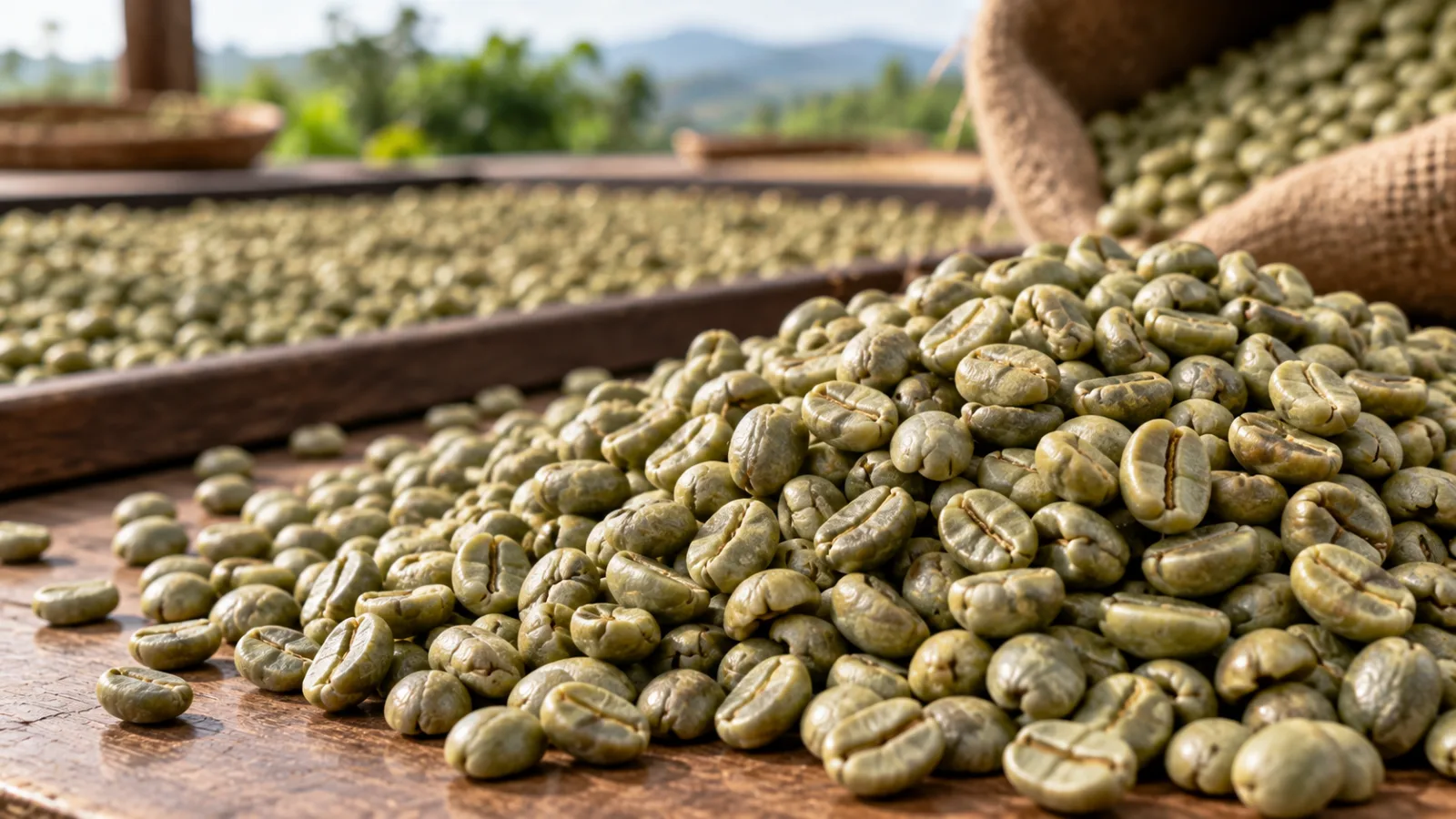
Central-belt Uganda Robusta coffee is natural-processed: cherry dried whole to kiboko, hulled to FAQ, then graded by screen at grading factories in and around Kampala into Screen 18, 17, 15 and 12 and BHP. A small quantity is washed and sold as single-origin Robusta. See processing.
Cup
Full body, low acidity, cocoa and cereal notes, a neutral clean finish — the profile that makes Uganda Robusta a standard component of Italian espresso blends. Lots from older shade-grown gardens at higher altitude are denser and sweeter.
West Nile
In the far north-west, on the highlands of Zombo, Nebbi and Arua districts between roughly 1,300 and 1,800 metres, Arabica has expanded since the 2000s. The coffee is processed both washed (sold as Wugar) and natural (Drugar) and harvested in two windows, similar to the Rwenzori. Volumes are smaller than Elgon or Rwenzori, quality is improving quickly as washing stations are built, and the area is of growing interest to specialty exporters. Grades: Drugar and Wugar.
Traceability
Uganda's national coffee farmer registration and plot-mapping programme covers the central belt, where most of the country's roughly 1.6 million registered coffee farms are located. Trader-aggregated kiboko is traceable to district and buying-centre level; lots from organised farmer groups can carry plot geolocation. Traceability level is stated per lot; see EUDR.
Frequently asked questions
Where is Robusta grown in Uganda?
Mainly in the central districts around Lake Victoria — Mukono, Kayunga, Buikwe, Luwero, Nakaseke, Mityana, Mubende, Masaka, Kalungu and Bukomansimbi — and in western districts such as Bushenyi, Kasese and Kamwenge.
What Robusta varieties grow in Uganda?
The traditional Nganda (spreading) and Erecta (upright) types, together with Kisansa and clonal lines released by Uganda's coffee research programme, which are wilt-resistant and larger-beaned.
When is Robusta harvested in central Uganda?
The main crop runs from about October to February, with a fly crop from May to August. Western districts follow a roughly opposite cycle.
Is West Nile coffee Arabica or Robusta?
The West Nile highlands (Zombo, Nebbi, Arua) grow Arabica, processed washed (Wugar) and natural (Drugar). It is Uganda's newest Arabica area and volumes are still small.
Is the Katonga river connected to coffee?
Only geographically — the Katonga basin's wetlands lie in the western part of the central Robusta belt. It is a landmark, not a grade or a brand.