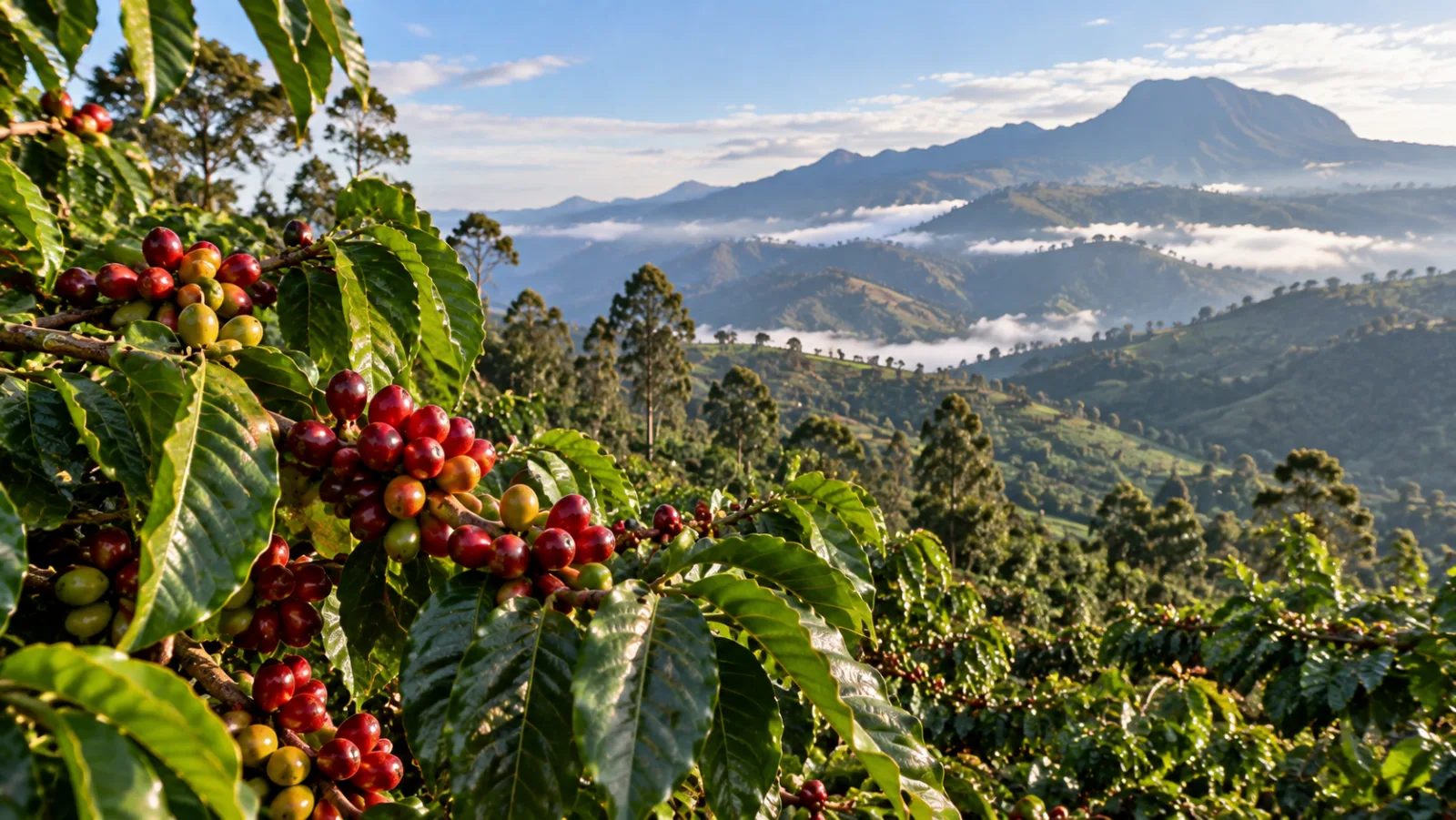
The mountain
Mount Elgon rises to 4,321 metres on Uganda's eastern border with Kenya. Its lower and middle slopes — between roughly 1,400 and 2,300 metres — are densely settled smallholder country where coffee grows under banana and shade trees on deep, free-draining volcanic soil. Rainfall is well distributed, nights are cool and the dry season from about November to February coincides with harvest, which favours clean drying.
Bugisu and Sebei
The Bugisu sub-region (Mbale, Sironko, Bududa, Manafwa and Bulambuli districts) occupies the western and southern slopes and gives its name to the Bugisu grade. To the north, the Sebei sub-region (Kapchorwa, Kween and Bukwo) climbs higher, and the coffee grown around the Sipi Falls escarpment is marketed as Sipi Falls coffee by specialty exporters and cooperatives. Both are washed Arabica; Sipi lots tend to come from higher gardens and are often graded and priced as Bugisu AA or Mount Elgon A+.
Varieties and farming
Traditional SL14 and SL28 selections, Nyasaland (a Typica-derived line) and KP varieties predominate, with newer releases being planted. Farms are small — often under a hectare of coffee — and part of cooperative structures such as the long-established Bugisu Cooperative Union and many newer primary societies and private washing-station networks. Where a lot comes from a named cooperative or station, we say so only with that organisation's consent.
Processing
Ripe cherry is delivered to washing stations, pulped the same day, fermented for 24–48 hours, washed and graded in channels, then dried slowly on raised beds to parchment. Dry parchment moves to a grading factory in Mbale or Kampala for hulling, screen grading, density sorting and hand or optical sorting. Some smallholders still process at home with hand pulpers; well-run station coffee is more uniform. Details on the processing page.
Harvest and shipment
Harvest runs from October to February with the peak around December. After drying and milling, fresh-crop washed Bugisu is typically ready for shipment from about January, with the bulk shipping February to May.
Cup
Bright citric to winey acidity, medium-to-heavy body, blackcurrant and dark-fruit notes, dark chocolate in the finish. Higher Sipi lots show more florals and a longer, cleaner finish. Scores in the 84–87 range are common from good stations; we publish scores only from cupping reports for the lot on offer.
Grades from Mount Elgon
- Bugisu AA and A — the region's standard washed grades.
- Mount Elgon A+ and Sipi Falls lots — origin-graded washed Arabica, reported export value US$8.24/kg for Mount Elgon A+ in December 2025 (MAAIF).
- Some natural (Drugar-style) lots are produced experimentally.
Traceability
Mount Elgon is one of the regions where washing-station delivery records make lot-level traceability practical, and where the national farmer registration and plot-mapping programme supports EUDR geolocation. Traceability level is stated per lot; see EUDR.
Frequently asked questions
What is Sipi Falls coffee?
Washed Arabica grown on the northern slopes of Mount Elgon around the Sipi Falls escarpment in Kapchorwa and Kween districts, typically between 1,600 and 2,100 metres. It is marketed under the Sipi name by specialty exporters and is usually graded as Bugisu AA or Mount Elgon A+.
How high is coffee grown on Mount Elgon?
Most coffee grows between roughly 1,600 and 2,000 metres, with gardens ranging from about 1,400 to 2,300 metres. The altitude of a specific lot is stated only where it has been verified.
What varieties grow on Mount Elgon?
Mainly SL14, SL28, Nyasaland and KP selections, with newer released varieties being planted. Variety is stated per lot where verified.
When is Mount Elgon coffee harvested?
October to February, peaking around December. Fresh-crop washed Bugisu is typically ready to ship from January.
Is Mount Elgon coffee organic?
Much of it is grown with few or no agrochemicals, but that is not the same as certified organic. Organic can only be claimed for lots from certified groups with valid certificates, and we state certification only where a certificate number is on file.