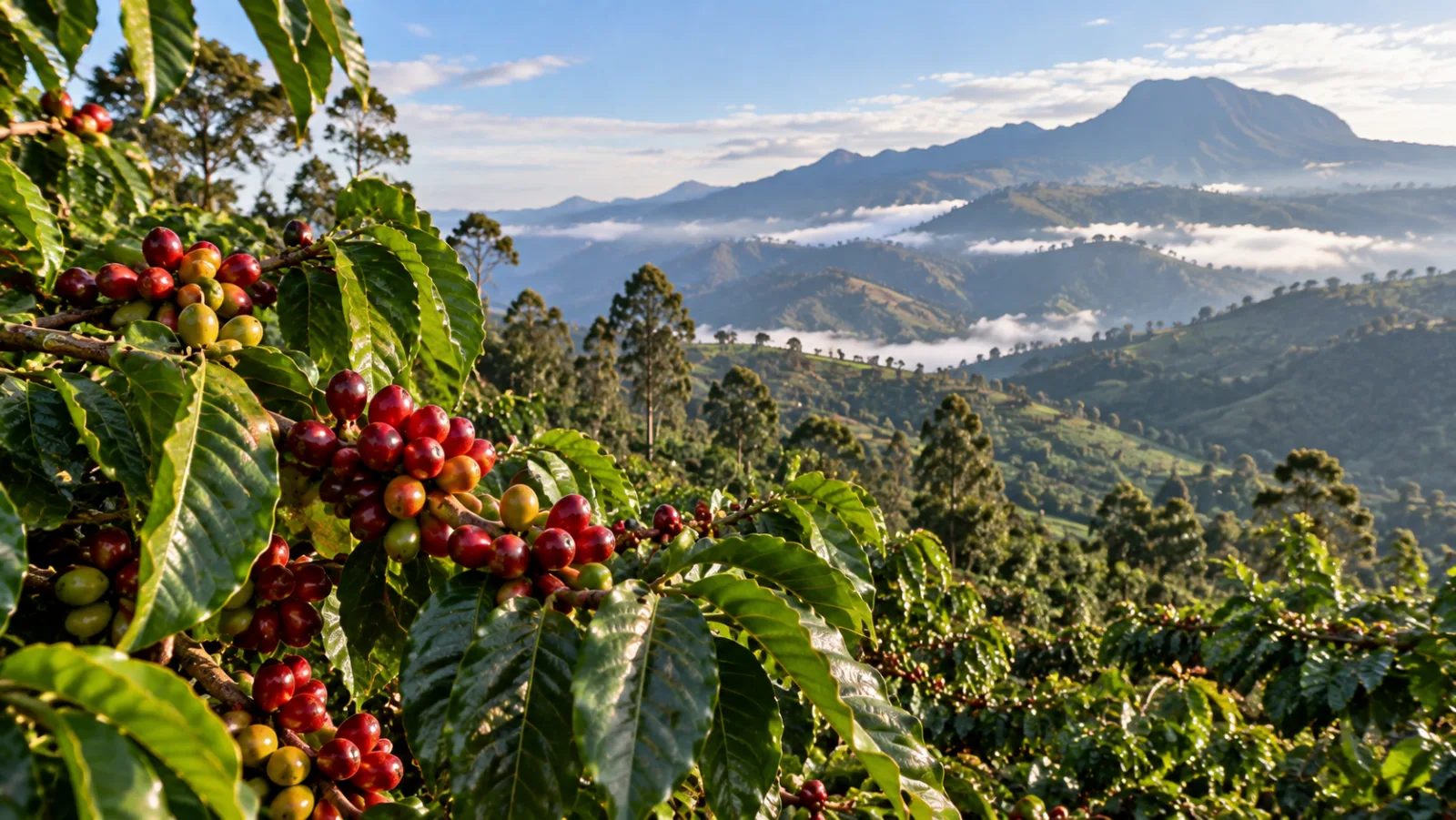
Geography
Mount Elgon is an extinct volcano on Uganda's eastern border with Kenya, rising to 4,321 metres. Coffee grows on its western and southern slopes in the Bugisu sub-region (Mbale, Sironko, Bududa, Manafwa, Bulambuli) and higher on the northern slopes in Sebei (Kapchorwa, Kween, Bukwo), where the Sipi Falls name is used. Soils are deep and volcanic; the dry season from about November to February coincides with harvest.
The Rwenzori is a non-volcanic range on the western border with the Democratic Republic of the Congo, rising to 5,109 metres. Coffee grows on the foothills and lower slopes in Kasese, Bundibugyo, Kabarole, Ntoroko and Bunyangabu. Rainfall is bimodal, which gives the region two harvests and a different supply rhythm. Regional guides: Mount Elgon and Rwenzori.
Processing and grades
| Mount Elgon | Rwenzori | |
|---|---|---|
| Dominant process | Fully washed at cooperative and private washing stations | Both: washed (station) and natural (home-dried cherry) |
| Grades | Bugisu AA, A, B, PB; Mount Elgon A+; Sipi lots | Rwenzori AA (washed, origin-graded); Wugar (washed); Drugar (natural) |
| Varieties | SL14, SL28, Nyasaland, KP | SL14, SL28, Nyasaland, KP, local selections |
| Typical altitude | 1,600–2,000 m | 1,400–2,200 m |
| Traceability | Station delivery records make plot-level data practical | Station lots traceable; trader-aggregated Drugar harder |
Grade pages: Bugisu AA and A · Drugar and Wugar.
Harvest and shipment timing
Mount Elgon harvests once, from October to February, with fresh washed Bugisu ready to ship from about January and the bulk moving February to May. The Rwenzori harvests twice — roughly March to June and October to December — so fresh lots arrive around May–August and December–February. A roaster who wants a Uganda washed Arabica in the second half of the calendar year is more likely to find a fresh Rwenzori lot than a fresh Bugisu one; a roaster who wants a single annual contract finds Bugisu's one long season simpler. See the harvest calendar.
In the cup
Bugisu / Sipi (washed): the classic washed East African profile — citric to winey acidity, medium-to-heavy body, blackcurrant and dark fruit, dark chocolate in the finish; higher Sipi lots add florals and length. Rwenzori washed: fuller and rounder, with plum and blackberry rather than blackcurrant, cocoa, and a rounded acidity; the best station lots are complex and sweet. Drugar (Rwenzori natural): heavy, sweet, dried fruit, low acidity — the espresso-blend workhorse of Uganda Arabica and, well sorted, a natural single origin. These are family descriptions; the descriptors and scores we publish for a lot come only from its cupping report.
Value
Uganda's reported export unit values in December 2025 (MAAIF export report, via VirginCoffee, February 2026) put Rwenzori AA at US$13.34 per kilogram — the highest of any Uganda Arabica grade — against Mount Elgon A+ at US$8.24, Bugisu AA at US$7.75, Wugar at US$7.93 and Drugar at US$7.13. The gap between Rwenzori AA and Bugisu AA reflects small volumes of named-station washed coffee sold with cupping data to specialty buyers, not a general ranking of the mountains. Historical values are orientation only; Arabica is quoted against the New York "C" contract plus a differential, or outright for specialty lots, FOB Mombasa.
Which to choose
- A washed single origin with a recognised name: Bugisu AA or a Sipi lot — the name is known to your customers and the supply is deep.
- A fuller, fruit-forward washed lot for a seasonal feature: Rwenzori AA from a named station, contracted against a sample.
- Sweetness and body in an espresso blend: Drugar.
- Fresh Uganda Arabica twice a year: alternate Bugisu (January) with Rwenzori (mid-year).
Evaluation samples from both regions can be requested together on the sample form; current lots are on the offer list.
Frequently asked questions
Is Bugisu or Rwenzori coffee better?
Neither is better; they are different. Bugisu is a brighter, blackcurrant-and-chocolate washed cup from Mount Elgon with one long harvest; Rwenzori washed lots are fuller with darker fruit, and the region also produces most of Uganda's natural Drugar, with two harvests a year.
What is Sipi Falls coffee?
Washed Arabica from the northern slopes of Mount Elgon around Kapchorwa and Kween, typically 1,600–2,100 m, marketed under the Sipi name and usually graded as Bugisu AA or Mount Elgon A+.
Why is Rwenzori AA more expensive than Bugisu AA?
In December 2025 Rwenzori AA's reported export value (US$13.34/kg) reflected small volumes of named-station washed coffee sold with cupping data to specialty buyers. Bugisu AA (US$7.75/kg) is a much larger, more commercial category. Lot quality, not the mountain, sets the price.