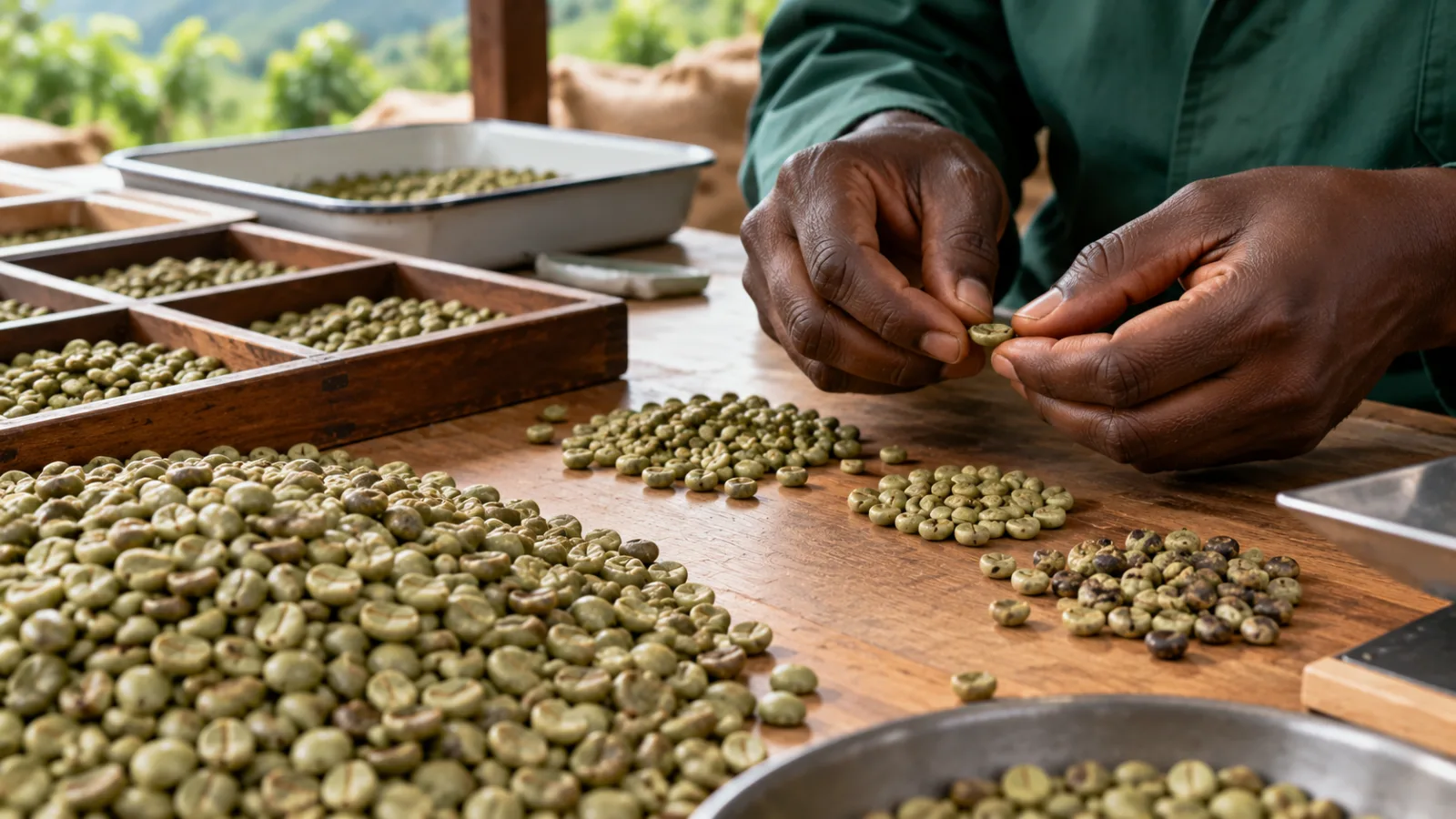
What a grade is — and is not
Uganda grades green coffee by physical characteristics: the sieve the beans are retained on, the number of defects per sample, and moisture. A Screen 18 Robusta is a large, uniform bean prepared to a defect tolerance; the grade does not say how it cups. That is why we publish grading data and cupping data separately, and why a sample matters.
Screen sizes
Grading sieves have round holes measured in 64ths of an inch. Beans retained on a sieve are “above” that screen.
| Screen | Hole diameter | Used for |
|---|---|---|
| 18 | 18/64" ≈ 7.14 mm | Robusta Screen 18; Arabica AA (with 17) |
| 17 | 17/64" ≈ 6.75 mm | Robusta Screen 17; Bugisu AA threshold (≈90% above 17) |
| 15 | 15/64" ≈ 5.95 mm | Robusta Screen 15; Arabica A threshold |
| 14 | 14/64" ≈ 5.56 mm | Arabica B |
| 12 | 12/64" ≈ 4.76 mm | Robusta Screen 12; below 12 = BHP / undergrade |
Robusta grades
| Grade | Standard | Notes |
|---|---|---|
| Screen 18 | Retained on 18; minimum retention and defect tolerance per standard | Largest whole-bean grade; espresso, premium soluble |
| Screen 17 | Retained on 17 | Often combined as 17/18 |
| Screen 15 | Retained on 15 | Benchmark export grade (51.7% of Robusta exports, Dec 2025) |
| Screen 12 | Retained on 12 | Small whole beans; soluble, industrial blends |
| BHP (e.g. BHP 1199) | Broken hand-picked: brokens and smalls passing screen 12, foreign matter removed | Industrial grade |
| Washed Robusta | Wet-processed, graded as above | Small premium category |
Grade pages: Screen 18 · Screen 15, 17 and 12 · Single-origin and specialty Robusta.
Arabica grades
| Grade | Process | Standard |
|---|---|---|
| Bugisu AA | Washed, Mount Elgon | About 90% above screen 17; low defect count |
| Bugisu A | Washed, Mount Elgon | Above screen 15 |
| Bugisu B | Washed, Mount Elgon | Above screen 14 |
| Bugisu PB | Washed, Mount Elgon | Peaberry (single round bean) |
| Mount Elgon A+ / Rwenzori AA | Washed, origin-graded | Exporter-defined premium preparations meeting or exceeding AA |
| Wugar | Washed, other regions | Graded by screen and defects |
| Drugar | Natural | Graded by screen and defects |
Grade pages: Bugisu AA and A · Drugar and Wugar.
Defects
Defects are counted in a 300 g (Robusta) or 350 g (Arabica, SCA method) sample. Primary defects are full black beans, full sour beans, dried cherry (pods), fungus-damaged beans and foreign matter (stones, sticks); secondary defects include partial blacks and sours, parchment, floaters, immature (quakers), withered, shells, brokens and insect damage. Uganda's export standard sets tolerances per grade; fine Robusta and specialty Arabica standards require zero primary defects. Our lot pages publish the measured defect count from the grading report.
Moisture
Green coffee for export must not exceed 12.5 percent moisture; well-prepared lots ship at 11–12.5 percent. Coffee above 12.5 percent risks mould and flavour loss in transit; coffee well below 10 percent has usually been over-dried and loses cup quality. Moisture is measured with a calibrated meter at grading and published per lot. Water activity is measured on request for specialty lots.
How grading is done
At the grading factory the hulled coffee is cleaned and destoned, passed over a bank of vibrating screens to separate sizes, run through a gravity (density) table to remove lights, and colour-sorted by machine and, for specialty lots, by hand. A sample is drawn from the finished lot for screen analysis, defect count, moisture and cupping; the coffee authority's inspector samples again for the quality certificate before export.
Reading a grading report
A grading report for a lot should show: lot reference; species and grade; sample weight; screen analysis (percentage retained on each sieve); moisture; defect count by type; a note on colour and uniformity; and the date and grader. A cupping report shows the protocol used (SCA Arabica or CQI/UCDA fine-Robusta), the roast, the scores by attribute and the descriptors. If a supplier cannot produce both for a lot on offer, ask why. To get grading data against your own specification, request a quote.
Frequently asked questions
What does Screen 18 mean in coffee?
Beans retained on a grading sieve with 18/64-inch (about 7.14 mm) round holes. Screen size is the primary grade criterion for Uganda Robusta and a component of Arabica grading.
What is the difference between Bugisu AA and Bugisu A?
Bean size and preparation. AA has about 90 percent of beans above screen 17 with a low defect count; A is above screen 15 with a slightly wider tolerance. Both are washed Mount Elgon Arabica.
What moisture content should green coffee have?
Uganda's export standard is a maximum of 12.5 percent; 11–12.5 percent is typical for well-prepared coffee. Lower than about 10 percent usually means over-drying.
What is a primary defect?
A defect that seriously affects the cup or the safety of the coffee: full black and full sour beans, dried cherry, fungus damage and foreign matter. Specialty and fine-Robusta standards allow none.
Does a higher grade mean a better-tasting coffee?
Not necessarily. Grade describes size and defect standard; cup quality is assessed separately by cupping. Larger beans are often denser and roast more evenly, but a well-prepared Screen 15 can cup better than a poorly prepared Screen 18.