Company and licence
1. What is your registered legal name and URSB registration number? A Ugandan company is registered with the Uganda Registration Services Bureau and its number can be checked on the public register. A supplier who cannot give you the registered name is not a company you should pay.
2. Under which export marketing licence will my coffee ship? Every coffee export from Uganda moves under an annual export marketing licence issued by the Department of Coffee Development at MAAIF, backed by a performance bond and access to a grading factory. Some suppliers hold their own licence; others source and prepare the coffee and ship through a licensed exporter. Both are legitimate; the answer must be specific and, in the second case, must name the licensed exporter. Our exporters page explains the system.
3. Where are you physically, and who will I be dealing with? A street address in Uganda and a named person with a direct telephone number. Ask for a video call from the grading factory or warehouse during the harvest.
The coffee
4. Which grades do you actually have, and from which harvest? Expect a specific answer — "Screen 15 and Screen 18 from the central belt, 2026/27 main crop, available from January" — rather than a list of everything Uganda produces. The harvest calendar tells you what is plausible in a given month.
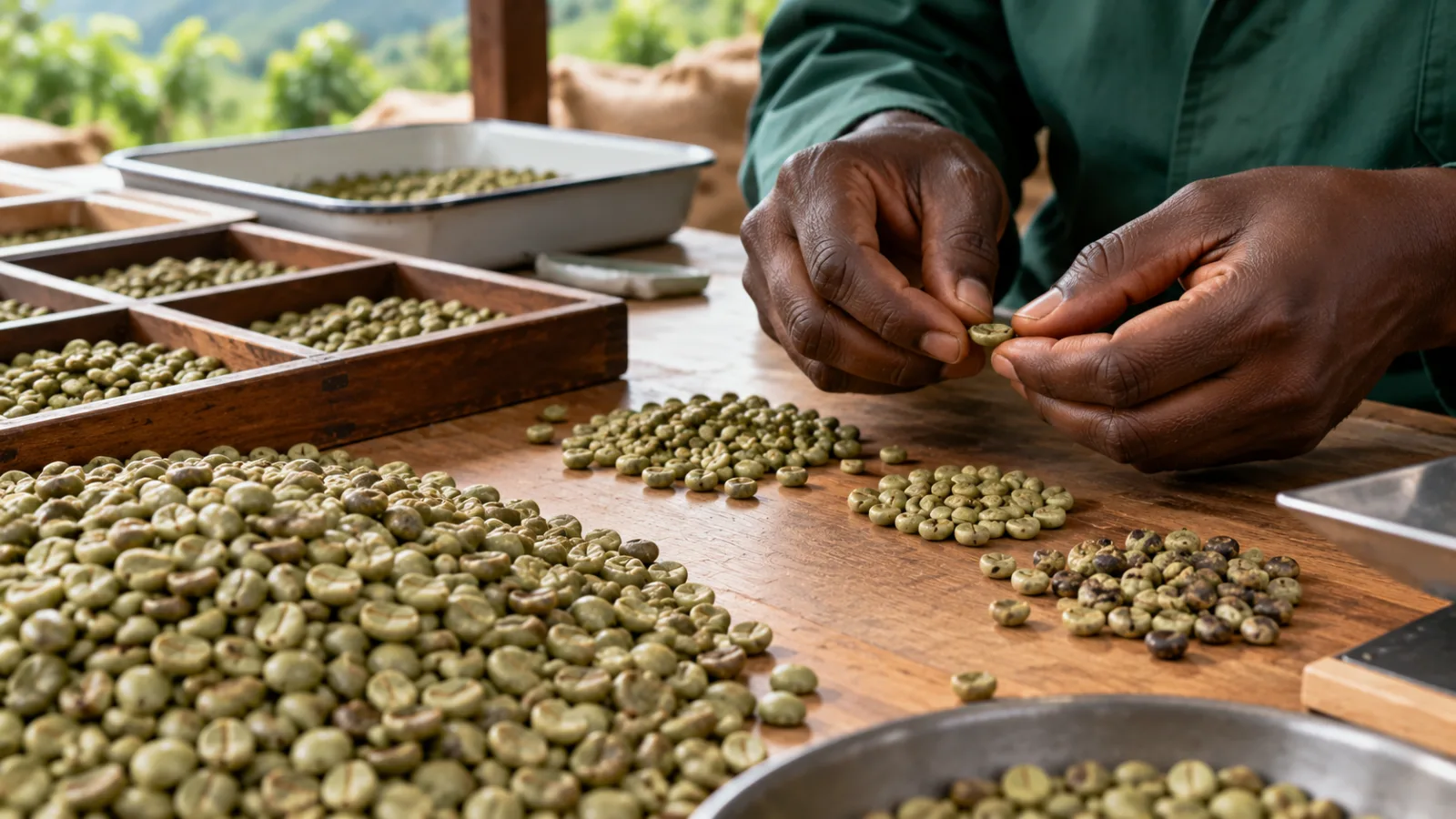
5. Can I see the grading report for the lot on offer? Moisture, defect count per 300 g and screen retention, measured at the grading factory, with the date and the grader. A supplier who offers a "specification" without measurements is offering a target, not a lot. Our grades page explains how to read the report.
6. Has the lot been cupped, and by whom? Cup scores and descriptors should come from a cupping report — SCA protocol for Arabica, the CQI or UCDA fine-Robusta protocol for Robusta. "Chocolatey, full-bodied" without a report is a description of Uganda Robusta in general, not of the lot.
7. What is the traceability level? Plot-level (registered farmer groups or washing stations with delivery records and mapped plots) or district-level (trader-aggregated coffee). Neither is wrong, but the answer determines what the supplier can provide for EUDR and for your own sustainability reporting.
Samples and quality control
8. Will you send an evaluation sample of the actual lot, and how quickly? Typically 300 g by courier within a week. Ask whether the sample is drawn from the lot on offer or is a type sample of the grade.
9. Will a pre-shipment sample be drawn from the prepared export lot, and will you wait for my approval before stuffing? The right answer is yes, always. The PSS is the buyer's control point; a supplier who resists it is asking you to accept quality on arrival.
10. Do you keep retained samples? Retained samples from the PSS and shipment are what make an arrival discrepancy resolvable rather than an argument.
Commercial terms
11. What is your price basis? Uganda Robusta is quoted as a differential to the London (ICE Europe) Robusta contract and Arabica against the New York "C" contract, FOB Mombasa, for a stated shipment month; specialty lots may be quoted outright. A price with no basis, no Incoterm and no shipment month is not a quote. Our importing guide explains the terms.
12. What payment terms do you offer a first-time buyer? Letter of credit at sight, or telegraphic transfer with a deposit and the balance against shipping documents, are normal. Be cautious of full prepayment to a supplier you have not verified, and of a supplier who refuses an LC.
13. Which contract rules apply? European Contract for Coffee (ECF) or Green Coffee Association (GCA) rules, with arbitration. Ask which and read them.
Documents and logistics
14. Which documents will accompany the shipment, and when will I see copies? Commercial invoice, packing list, bill of lading, ICO certificate of origin, quality certificate and phytosanitary certificate as a minimum, with copies emailed as issued and originals couriered or presented under the LC. The documents page describes each.
15. How do you move coffee to Mombasa, and what transit should I plan for? Two to three days by road or by rail from Kampala to Mombasa; then roughly 18–24 days to Mediterranean ports, four to five weeks to northern Europe and the UK, 28–35 days to the US East Coast. A supplier should be able to tell you their forwarder or clearing agent and how they handle the container inspection.
How we answer these
Our answers to questions 1 to 3 are sent with every offer and published in the site footer as they are confirmed. Questions 4 to 10 are answered per lot on the offer list and in the grading and cupping reports. Questions 11 to 15 are answered in the quote and on the pages linked above. If any answer on this site is missing, it is because we would rather say "available on request" than guess.
Frequently asked questions
How do I verify a Uganda coffee exporter's licence?
Ask for the licence number or the licensed exporter partner's name and confirm it with the Department of Coffee Development at MAAIF, which publishes lists of licensed exporters. Combine this with a URSB company check and documents from a real shipment.
Should I pay a Uganda coffee supplier in advance?
Not in full to an unverified supplier. Normal first-shipment terms are a letter of credit at sight or a deposit with the balance against shipping documents. Pre-shipment sample approval before stuffing protects you further.
What is a pre-shipment sample?
A sample drawn from the finished, bagged export lot and sent to the buyer for approval before the container is stuffed. It is the buyer's quality control point and should always be offered.