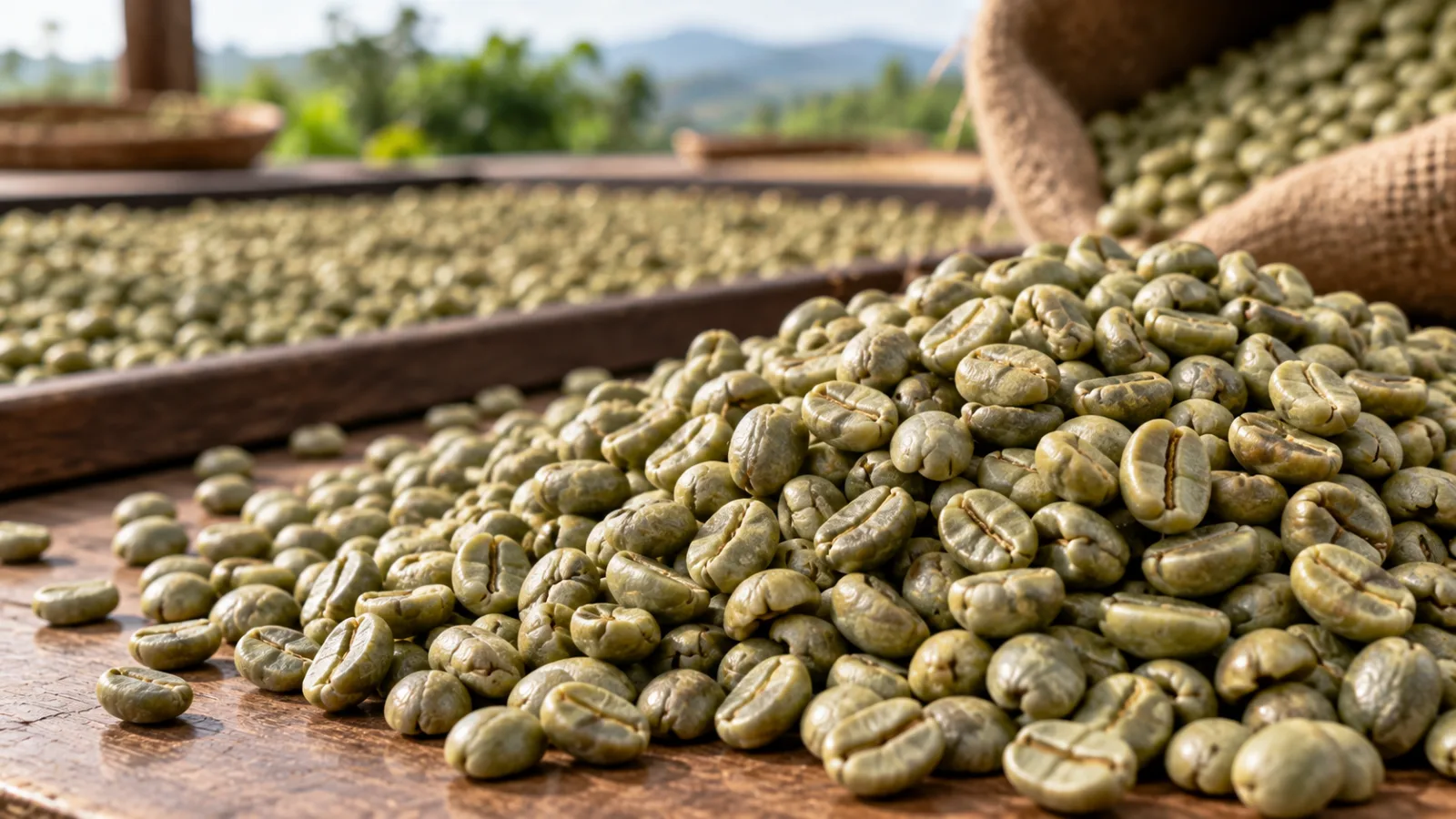
The short answer
Choose Screen 18 when uniformity matters more than cost: single-origin Robusta, espresso blends where the Robusta share is high enough to be tasted on its own, and premium soluble where yield and flavour are specified together. Choose Screen 15 when you need the liquid, widely traded benchmark grade for a blend or an industrial process, want the most supply options and the tightest differential, and will control the roast to accommodate a wider bean-size range. Many roasters buy both and use them for different products.
What the numbers mean
Uganda grades hulled Robusta by passing it over sieves with round holes measured in 64ths of an inch. Screen 18 beans are retained on the 18/64-inch sieve, about 7.14 mm; Screen 15 beans on the 15/64-inch sieve, about 5.95 mm. A Screen 15 lot therefore contains beans from roughly 6 mm up to whatever was not removed as 17s and 18s — in practice a preparation that spans a wider size range than Screen 18. Screen 17 sits between them and is often combined with 18 as a "17/18" preparation. Details on sieves, defects and moisture are on the grades page.
Density and roast behaviour
Larger beans from the same trees are generally more mature and denser. In the roaster that shows up as more even colour development across the batch, fewer tipped or scorched small beans, and a more predictable first crack. Screen 15's wider size distribution roasts perfectly well in commercial equipment but rewards a slightly gentler charge and a profile that lets the smaller beans catch up; roasters who move from 18 to 15 without adjusting the profile sometimes report unevenness that the grade, rather than the coffee, explains.
In the cup
Both grades share the Uganda Robusta character: full body, low acidity, cocoa and cereal notes and a clean, neutral finish that blends without harshness. Well-prepared Screen 18 tends to be a little sweeter and cleaner because size correlates with maturity and because the grade carries fewer small, immature beans. Screen 15 from a good grading factory can cup very close to 18; the difference is more visible in uniformity than in flavour. We publish cup descriptors only from cupping reports for the lot on offer — the same rule that applies to every lot on our offer list.
Price
Uganda Robusta is priced as a differential to the London (ICE Europe) Robusta contract, FOB Mombasa, for a stated shipment month. In December 2025 Uganda's reported export unit values were US$4.54 per kilogram for Screen 18 and US$4.44 for Screen 15 (MAAIF export report, via VirginCoffee, February 2026) — a premium of about ten cents per kilogram, or roughly US$190 on a 19.2-tonne container. For a blend at 20 percent Robusta that is a fraction of a cent per cup; for a premium soluble line specified on Screen 18 it is the cost of uniformity and marketing clarity. We do not publish live prices; request a quote for a current offer basis.
Supply and liquidity
Screen 15 was 51.7 percent of Uganda's Robusta exports in December 2025 and Screen 18 was 12.1 percent (same source). Screen 15 is what most exporters carry as their reference grade, what most importers hold in warehouse, and what most contracts cite, so alternative supply is easiest to find. Screen 18 volume is real but smaller; during the fresh-crop window (December to May for the central belt) it is readily available, and later in the season buyers who need 18 should contract early. See the harvest calendar.
Who buys which
| Buyer | Typical choice | Why |
|---|---|---|
| Espresso blenders (Italy, Germany, UK) | Screen 18 or 17/18 for premium blends; Screen 15 for standard blends | Crema and body from Robusta; uniformity in the premium line, cost in the standard line |
| Specialty roasters | Screen 18; washed or fine Robusta lots | Single-origin or high-percentage Robusta espresso where appearance and uniformity matter |
| Soluble manufacturers | Screen 15 and 12; Screen 18 for premium instant | Yield and consistency; 18 where the product is marketed on quality |
| Traders and importers | Screen 15 as the reference; 18 and 12 as differentials | Liquidity |
A practical way to decide
- Roast and cup both grades from the same origin and crop, side by side, at the roast level you actually use.
- Cup them in the blend at the intended percentage rather than only as single origins; a difference that is obvious at 100 percent may vanish at 15 percent.
- Cost the difference per finished unit, not per kilogram of green.
- Check the grading report for both: measured moisture, defect count and screen retention tell you about the specific lot, which matters more than the grade name.
Samples of both grades can be requested together on the sample form; the Screen 18 and Screen 15 pages carry the standard specifications.
Frequently asked questions
Is Screen 18 Robusta better than Screen 15?
It is larger and more uniform, and often slightly sweeter and cleaner because size correlates with bean maturity. Whether it is better for you depends on the product — Screen 15 is the benchmark grade for blends and soluble; Screen 18 suits single origins, premium blends and premium instant.
How much more does Screen 18 cost than Screen 15?
Uganda's reported export values in December 2025 differed by about ten US cents per kilogram (US$4.54 vs US$4.44), roughly US$190 per 20 ft container. Actual quotes are differentials to the London Robusta contract and change with the market.
Can I buy Screen 17 and 18 together?
Yes. Many contracts specify a 17/18 preparation — beans retained above the 17/64-inch sieve — which increases available volume with little change in cup.
Does Screen 15 roast differently from Screen 18?
Slightly. Its wider size range benefits from a gentler charge and a profile that gives smaller beans time to develop. Screen 18 roasts more evenly with less adjustment.